

Selling on WhatsApp in the Caribbean
Many Caribbean sales start with an ad and close in a WhatsApp chat. Where that breaks, how payment links help and what Meta's new message fees mean.
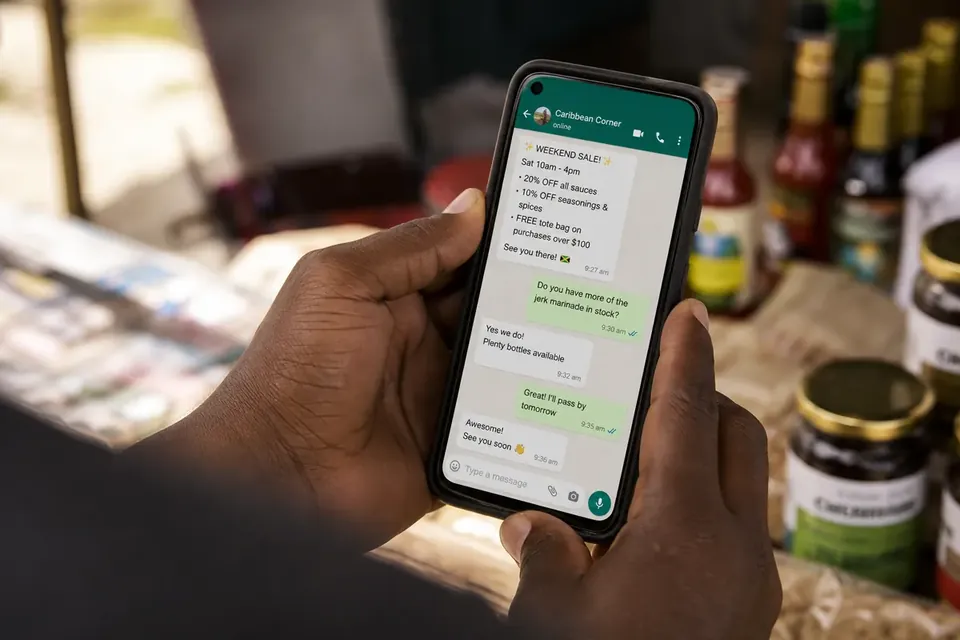
For many small businesses in Trinidad, Jamaica and Barbados, the shop is a WhatsApp chat. A customer sees an Instagram ad, sends a message asking about price and delivery, and the deal is agreed in the thread, often ending with a bank transfer screenshot.
That works well for trust, but it leaves money on the table. Orders get lost, payments are hard to confirm, and from 1 October 2026 Meta has started charging businesses on its paid WhatsApp platform for replies that used to be free.
How a typical sale happens
The path is familiar to anyone who sells online in the region:
- An ad runs on Facebook or Instagram.
- The buyer messages the business number, which is sometimes the owner's personal phone.
- Size, stock and delivery day are confirmed in the chat, often with photos.
- The seller sends bank details, a payment link or a checkout page.
- The order is marked paid when a screenshot arrives or the payment system confirms it.
Regional writers describe the same thing. "For many Caribbean businesses, WhatsApp isn't just a messaging app. It's the storefront," Caribbean Signals wrote in June (caribbeansignals.com).
Hard numbers are scarce. One research firm, Caribbean Market Research, estimates that social commerce through WhatsApp and Instagram makes up 8% of holiday spending, mostly in Trinidad and Jamaica, and that 12% of online shoppers still prefer cash on delivery (CMR). It does not publish its method, so treat those as rough estimates. Nobody publishes an audited count of how many Caribbean businesses sell this way.
The money goes to Meta, the sale happens in chat
Most digital ad money in the region goes to Facebook and Instagram. Hope Research Group puts Meta's share of Caribbean digital ad spend at 55%, though some of that study's other figures do not match independent data (our review).
Meta owns both the ads and WhatsApp, so the pieces should connect. In practice, the ad brings the customer in, but stock levels, deposits and payment are still handled by hand in the chat.
Where the chat sale breaks
When there is no proper website or checkout, the chat ends up doing all the work. The seller answers the same size questions over and over, chases proof of payment and keeps the customer list in their phone.
That creates three practical problems:
- You cannot tell which ads actually led to sales, because tracking stops when the customer taps "message."
- Repeat customers are hard to reach, because their history lives in one person's phone.
- Disputes are hard to settle, because there is no order number, only a conversation.
Diaspora buyers add another wrinkle. The person paying from New York or Toronto is often not the person receiving the parcel in San Fernando. A simple invoice number sent with the payment link, plus the recipient's name and phone, prevents most delivery mix-ups.
Payment tools that work inside the chat
Several Caribbean companies now let customers pay without leaving WhatsApp, or with one tap from a link.
In Jamaica, GraceKennedy Money Services launched WhatsApp Pay through its Bill Express brand in 2025. Customers pay bills and top up phone credit by chatting with a designated number, for a J$55 fee that is lower than the in-store charge (Jamaica Observer). It accepts local and overseas cards, which suits relatives paying from abroad.
In Trinidad and Tobago, Wam lets businesses send a payment link in WhatsApp or redirect customers to a hosted checkout page, and only marks an order paid when Wam's system confirms it (Wam docs). Our Wam post covers its fees and setup.
Guyana announced Fast Pay, an instant bank transfer system, for June 2026, though an official launch notice has not yet been published (our Guyana post). Instant bank transfers would help chat sellers too, as long as the confirmation reaches the seller as well as the buyer.
Meta's new fees
This change is easy to miss. It affects businesses that use the WhatsApp Business Platform, the paid service connected through a provider or an app, rather than the free WhatsApp Business app.
According to Meta's developer documentation:
| Date | Change |
|---|---|
| 1 July 2026 | Meta launches its own AI assistant for businesses, the Meta Business Agent |
| 1 August 2026 | Replies written by that assistant are charged, at about 4 to 5 US cents each |
| 1 October 2026 | Every reply a business sends to a customer is charged per message, even inside the 24-hour window that used to be free |
Meta says rates for these replies match its rates for utility messages in each country. Conversations that start from a click-to-WhatsApp ad still get a free window for delivery. If your business sends hundreds of replies a day through a platform provider, messaging is now a real cost per sale and belongs in your pricing.
Selling across islands and currencies
Chat handles language and trust well. It does not handle currency. Cards issued in one island may be declined in another, local wallets usually work in only one country, and bank transfers need exact account names.
The same pattern shows up beyond retail. Tourism operators selling villa nights or boat trips close many bookings in chat before any booking system sees them (tourism post). Energy service firms and creative studios in Trinidad agree jobs on WhatsApp and send the invoice later by email (energy hub post).
What to do next
- Give every order a number and send it with the payment link, so you can match payments to orders.
- Use a payment link or hosted checkout, and ship only when the payment system confirms the money.
- If you use the paid WhatsApp platform, check your provider's new per-message charges for October 2026 and work them into your margins.
- Write down the five questions customers ask most and save quick replies for them.
Watch for Meta's AI assistant to reach more Caribbean businesses, and for Wam, Bill Express and Guyana's Fast Pay to expand. The sellers who will do best are the ones who keep the friendly chat and add a proper order and payment trail behind it.