

Guyana's Fast Pay: what's live and what isn't
Guyana promised instant bank transfers from 2 June 2026 and a link to India's UPI. What is confirmed, what is still pending and why oil money matters.
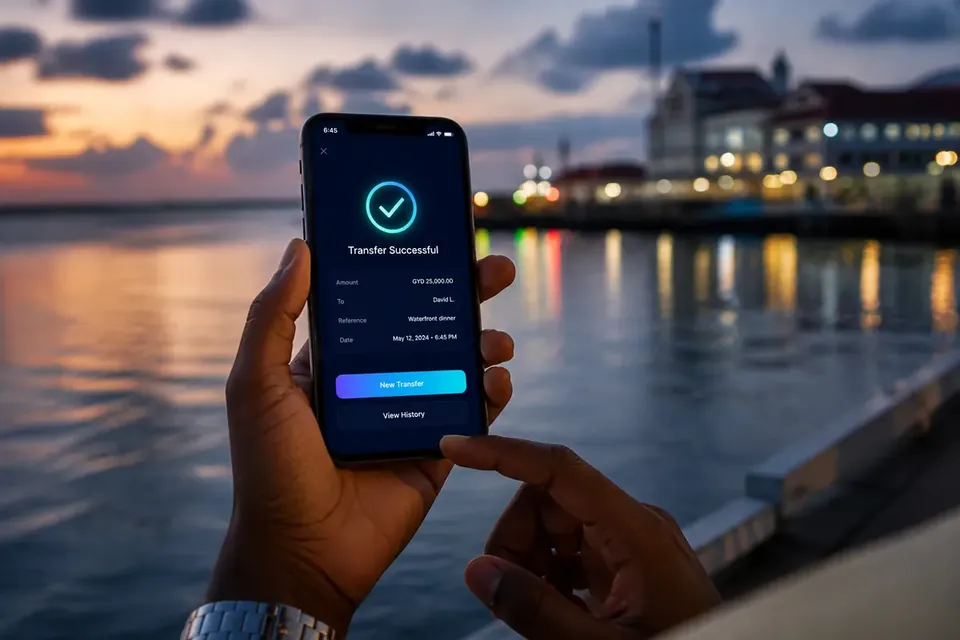
In May 2026, President Irfaan Ali announced that Fast Pay, a national system for instant bank transfers, would go live in Guyana on 2 June. If it works as described, a market vendor could be paid from any participating bank in seconds, with no card machine and no waiting days for a transfer to clear.
Four months later, the picture is less tidy than the headlines suggested. Here is what has been confirmed, what has not, and why Guyana's oil money sits in the background of all of it.
What was announced
Ali made the announcement at GBTI's 190th anniversary dinner in Georgetown on 16 May. According to the Office of the President, customers of all participating banks would be able to "send and receive funds instantly, at any time of day, seven days a week," using mobile or internet banking.
He announced a second step at the same time: linking Guyana to India's Unified Payments Interface (UPI). UPI is India's national instant payment system. It lets people pay using a simple address tied to their bank account, so they do not have to share account numbers. The groundwork goes back to November 2024, when India and Guyana signed ten agreements in Georgetown, including one with NPCI International, the company that exports UPI (India News Network).
Ali also said three international institutions had been licensed to operate in Guyana: Citibank, Crown Agents and One Americas. They will not take retail deposits.
Is Fast Pay actually live?
This is the part that is still unclear. Some business guides describe Fast Pay as launched on 2 June, with Republic Bank, GBTI and Demerara Bank among the participating banks (Guyana Directory). But a detailed guide from 592Hub, last checked on 26 September, found no official notice from the Bank of Guyana, the Ministry of Finance or the government's information office confirming that Fast Pay had launched (592Hub).
We could not find one either. The Bank of Guyana has not published fees or transaction limits for Fast Pay. On 24 September, Ali told Guyanese in New York that a national system for phone payments, bank transfers and bills would launch before the end of 2026, which suggests the full rollout is still to come.
The UPI link is further away. No go-live date has been published, and local guides describe it as planned for later in 2026.
If you do business in Guyana, the practical advice is simple: ask your bank whether instant transfers are switched on for your account. Mobile Money Guyana (MMG), GTT's mobile wallet, already handles person-to-person transfers, bills and merchant payments today.
What it could change for households and merchants
For families, instant transfers mean paying a bill, sending money to a relative or splitting a cost without cash or a trip to the bank. For small sellers, the bigger gain is skipping card fees. A vendor at Bourda Market who cannot justify a card terminal could take payment on the phone they already own.
The size of that saving is not yet known, because no Fast Pay fees have been published. A widely shared figure of a 0.33% merchant fee could not be verified and appears to come from Brazil's Pix system (592Hub).
India shows what the model can do at scale. UPI handled 22.64 billion transactions in March 2026 alone, according to La Caribeña News. Guyana's market is tiny by comparison, so the useful lesson is in how the system is designed.
Trinidad and Tobago signed first
Trinidad and Tobago was actually first in the region to sign up for UPI technology. Its Ministry of Digital Transformation signed an agreement with NPCI International on 10 September 2024, witnessed by Central Bank Governor Alvin Hilaire, who called it a "game-changer" (Ministry statement; NIPL release).
Two years on, neither country has a UPI-based system that the public can use, as far as official sources show. Instant payments in Georgetown would also not settle a Port of Spain invoice. Linking Caribbean payment systems across borders is a separate project with no public timetable.
Oil money sits behind the payments push
Guyana can move quickly partly because it has money. Between January and June 2026, the government deposited US$1.996 billion into its Natural Resource Fund, the account that collects oil revenue (OilNOW). Of that, US$1.779 billion was the government's share of profit oil and US$218.4 million came from royalties.
Under the 2016 production sharing agreement for the Stabroek Block, Guyana receives a 2% royalty. ExxonMobil and its partners can use up to 75% of the oil each month to recover their costs, and what remains is split evenly with the government.
That split is about to shift in Guyana's favour. On ExxonMobil's 31 July 2026 earnings call, finance chief Neil Hansen said the company had "fully recovered the $55 billion of investment" along with operating costs (Kaieteur News). Once costs are recovered, production is shared 50/50 after operating expenses, so Guyana's take should rise sharply. Kaieteur News noted the government had not publicly confirmed when that point was reached or how costs from new projects will be handled.
The growth figures need a footnote
The World Bank's January 2026 Global Economic Prospects report projected Caribbean growth of 5.2% in 2026 and 6.6% in 2027 (INews Guyana). Those averages are pulled up by Guyana alone, which is projected to grow 19.6% in 2026 and 21.9% in 2027.
| 2026 | 2027 | |
|---|---|---|
| Caribbean, including Guyana | 5.2% | 6.6% |
| Caribbean, excluding Guyana | 2.9% | 3.7% |
| Guyana | 19.6% | 21.9% |
Guyana's own budget projected 16.2% growth for 2026, with the non-oil economy growing 10.8% on the back of construction, manufacturing and agriculture.
For a business in Barbados or Trinidad, the second row is the one that describes your market. Planning around a "6% Caribbean" figure would overstate demand almost everywhere except Guyana.
Why it matters for small business
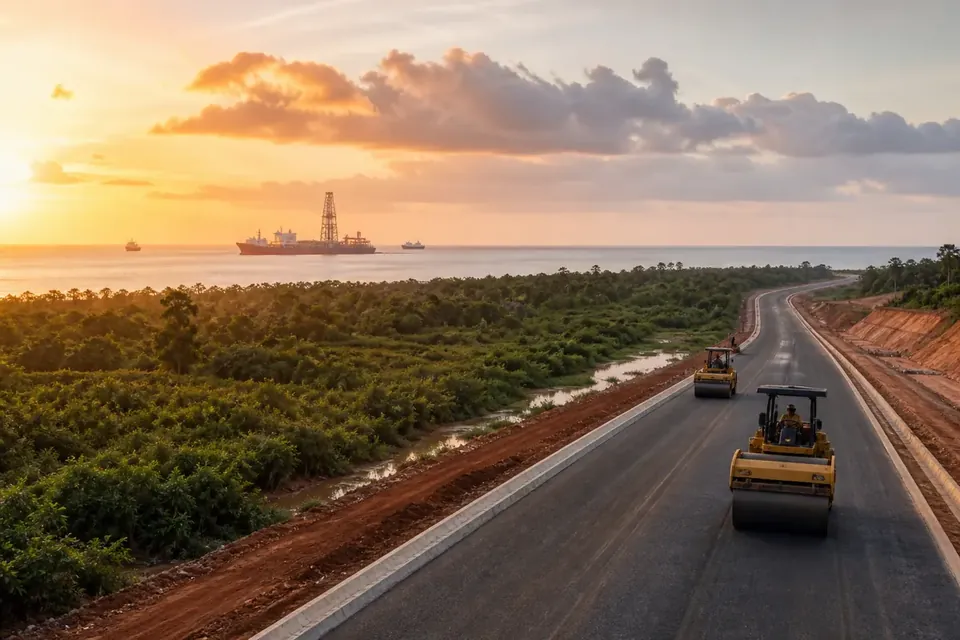
Oil money pays for roads, schools and housing. Instant payments do something smaller but closer to the ground: they cut the cost of each sale for the shops, contractors and transport operators that make up the non-oil economy. In a country growing this fast, those are the businesses that lose the most when payments are slow.
What to watch
- An official Bank of Guyana notice confirming Fast Pay is running, with its fees and limits.
- The national payment system Ali has promised before the end of 2026.
- A date for the UPI link, and whether Trinidad and Tobago's own UPI project moves forward.
- Whether the government publishes when ExxonMobil's cost recovery was completed and what that means for oil revenue in 2027.
If you sell into Guyana, ask your bank and your customers' banks what is switched on today, and keep MMG as a fallback until Fast Pay is confirmed.