

Paper digest: LaViDa-R1
Adobe researchers trained one AI model to reason about images, solve maths and edit pictures. What LaViDa-R1 does differently and where it falls short.
Researchers at Adobe, UCLA and Georgia Tech have trained a single AI model to reason through maths problems, answer questions about charts and edit images. Their February 2026 paper, LaViDa-R1, shows a new type of model can learn to "think" across text and pictures together.
It matters because most AI tools today use one model to understand images and a separate one to edit them. Combining them could make creative and document tools simpler and smarter.
The paper
LaViDa-R1: Advancing Reasoning for Unified Multimodal Diffusion Language Models, by Shufan Li, Yuchen Zhu, Kangning Liu, Zhe Lin, Yongxin Chen, Molei Tao, Aditya Grover, Jiuxiang Gu and Jason Kuen. Most of the work was done at Adobe Research. arXiv:2602.14147
Why this paper exists
Most chatbots write one word at a time, left to right. They are built on the Transformer design covered in our Attention Is All You Need digest.
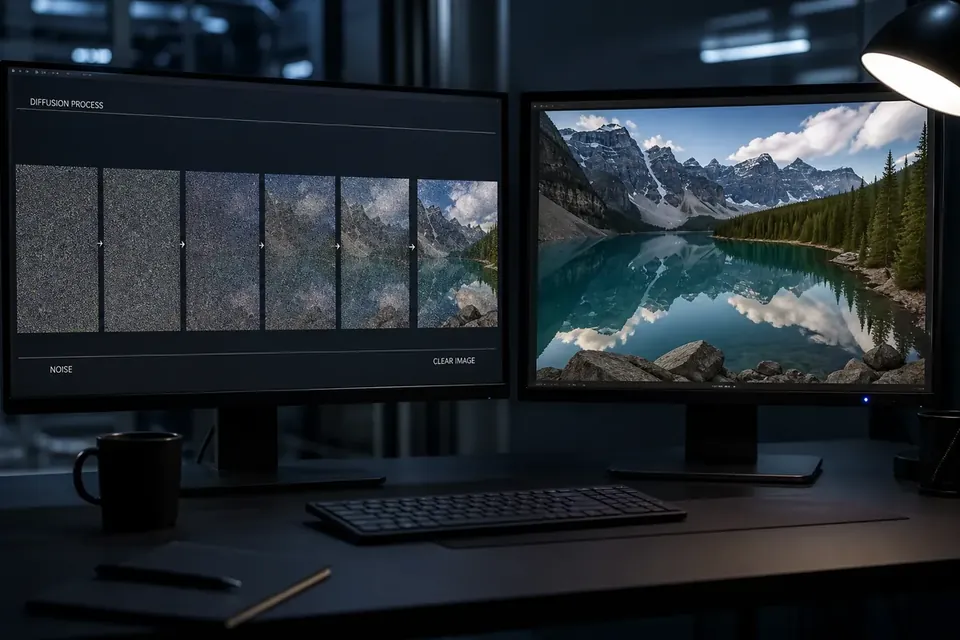
Diffusion language models work differently. They start with a blank, fully hidden answer and fill in words over several rounds, in any order. The same process can produce text and images, which makes them appealing for tools that do both.
Researchers have learned how to teach word-by-word models to reason step by step. Doing the same for diffusion models has mostly been tried on narrow tasks, such as maths alone. LaViDa-R1 tries it across many kinds of task at once.
How it works
The team started with an existing model, LaViDa-O, and focused on what happens after its initial training. They combined two common training methods:
- Supervised fine-tuning, where the model copies good example answers.
- Reinforcement learning, where the model tries answers, gets scored and learns from what worked.
Normally these are done separately. The authors showed they can be written as one formula and mixed in a single training step.
Getting help when every attempt fails
Reinforcement learning has a weak spot. If every answer the model tries is wrong, there is nothing to learn from. The authors added two fixes:
- Answer-forcing. When the correct answer is known, they place it at the end and let the model fill in the reasoning that leads to it. This only works because diffusion models can fill gaps in the middle of a text.
- Tree search. For image editing, where there is no single right answer, they take the best attempt partway through and try several new versions from that point.
Rewards depended on the task: correct answers for maths, how well a drawn box matched the right object for image location tasks, and a quality score for edits.
Results that moved
All figures are from the paper's tables. Scores are accuracy percentages unless noted.
| Test | What it checks | Starting model | After LaViDa-R1 training |
|---|---|---|---|
| GSM8K | School maths word problems | 47.4 | 81.5 |
| MATH-500 | Harder maths | 23.4 | 38.6 |
| MathVista | Maths using images | 56.9 | 60.0 |
| ChartQA | Questions about charts | 80.0 | 81.7 |
| Lisa-Grounding | Finding an object from a tricky description (mIoU) | 26.1 | 60.0 |
| ImgEdit | Image editing quality, scored out of 5 | 3.80 | 3.90 |
The biggest jump was in finding objects from descriptions that need reasoning. The score rose to 60.0, ahead of Alibaba's Qwen3-VL-8B at 56.6 in the paper's comparison.
Image editing is a telling result. Extra supervised training barely moved the score, from 3.80 to 3.81. The combined method lifted it to 3.90. OpenAI's GPT-4o still scored higher, at 4.20.
The authors also tested how much answer-forcing to use. Using it about 10 percent of the time worked best. Using it every time made the model collapse, because it learned to aim for the planted answer rather than reason.
Limits
The authors say plainly that their model still trails the best word-by-word models, such as Qwen3-VL. They think better initial training and bigger models are needed, not just smarter fine-tuning.
Diffusion models also lack the fast, mature software that word-by-word models have, which made training slow. The paper didn't cover multi-step tasks such as using tools or building websites. When the team tried rewarding reasoning before drawing an image, they found existing scoring models weren't good enough to judge it.
This is a training recipe tested on one starting model. It doesn't prove diffusion models will replace today's chatbots. For a related diffusion model that also handles speech, see our Omni-Diffusion digest.
Who should care
AI researchers working on diffusion models can reuse the main ideas: combining the two training methods and guiding the model when every attempt fails.
Teams building document reading, chart analysis or image editing tools should watch this direction. A single model that understands an instruction, finds the right part of an image and edits it could replace several separate tools.
For Caribbean studios and businesses buying AI tools, the practical lesson is to test reasoning, not just pretty results. Ask a vendor whether their tool can follow a tricky instruction, like "replace the logo on the second banner", and check whether it finds the right spot.
Bottom line
LaViDa-R1 shows a diffusion model can learn to reason across maths, images and edits with one training approach, with big gains in maths and in finding objects. Watch for larger diffusion models trained this way, and whether they close the gap with today's leading chatbots.